(serves 4)
120g/4oz margarine or butter
120g/4oz soft brown sugar
120g/4oz rolled oats
40g/1.5oz sultanas or raisins
15oz/428g can apricot halves (or stewed sweetened loquats or apricots)
1 tblsp lemon juice
Method:
Cream the butter and sugar, then stir in the oats and sultanas, mixing well. Drain the apricots, then tip the fruit into a 600ml/1 pint ovenproof dish. Sprinkle over a little apricot syrup mixed with lemon juice. Gently spoon the topping over the fruit and firm it with a knife. Cook for 30-40 minutes at 350F/ 180C/ Gas 4 until golden brown on top.
- - - - - - - - - - - - - - - - - - - - - - - - - - - - - - - - - - - - - - - - - - - - - - - - -
This is a very flexible dessert, ideal for the family or doubled when there are guests. The oven temperature isn't vital - it can be cooked along with anything else, although it's better to have it lower rather than higher.
Since we have a loquat (mespila) tree, I pick several kilograms each year and then freeze them in a light syrup, to use in this dessert. About 500g frozen fruit is right for this - I tip it straight into a saucepan, simmer until soft, and then use as if it were from a can. Sometimes when doubling I use a large can of pears mixed with loquats or apricots for a little variety.
This is excellent served with evaporated milk, or home-made ice cream or yogurt.
02/05/2006

01/05/2006
Tomato and Rosemary Bread
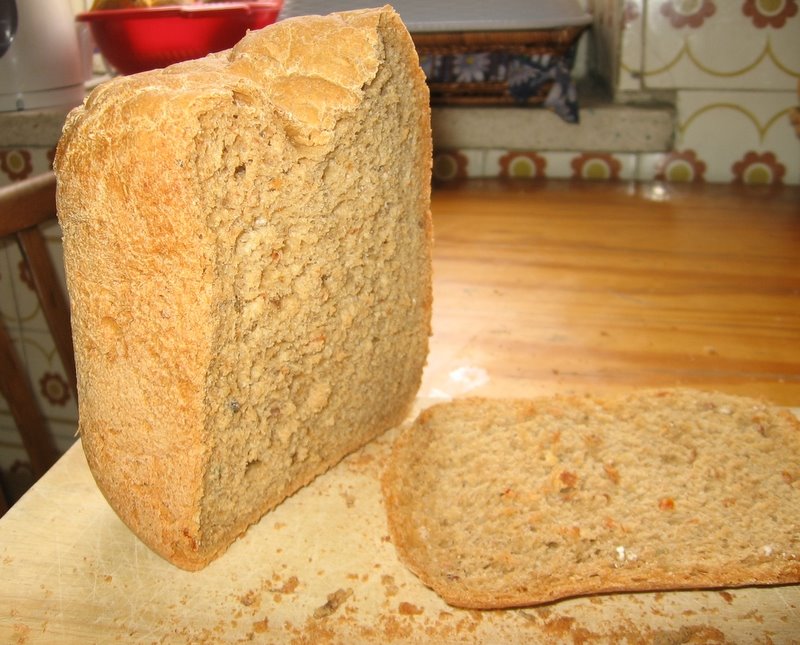 (makes a 1kg/2lb loaf)
50g sundried tomatoes in oil, chopped
2 tblsp oil (from the sundried tomato jar)
1 tsp dried rosemary
320ml lukewarm water (or half milk)
200g granary or malted flour
150g plain white flour
150g white bread flour
1 tsp salt
1 1/2 tsp instant dried yeast
Method:
Place the ingredients in a breadmaker in the correct order - usually liquids, then flours, then salt and yeast. Switch to the lightest crust, regular white bread setting.
- - - - - - - - - - - - - - - - - - - - - - - - - - - - - - - - - - - - - - - - - - - - - - - -
It took me a while to get the ingredients in the correct quantities for my breadmaker; for some reason the first few times I made it, the mixture was rather too wet and the result heavy and not very well-risen, though still tasty. I tend to use half soya milk when making this; for some reason the bread is a little firmer and easier to cut than when I use all water.
Jars of sun-dried tomatoes in oil which I've found seem to contain about 150g actual tomatoes, so I use about a third of the jar each time. The rest keep well in the fridge for at least a couple of weeks, perhaps more. The tomatoes can be added right at the beginning with the other ingredients, since the initial kneading chops them a little more and distributes them well.
We find this particularly good with cheese and marmite, or egg mayonnaise. It's also extremely good lightly spread with butter or Bertolli, when still warm.
I haven't tried this without a breadmaker, but it should work in the traditional way, with mixing, kneading, rising, knocking down, re-rising in a 1kg bread pan, and baking in the oven.
29/04/2006
Stifado
 (Serves 2-3)
500g (1lb) stewing beef, in chunks
2 large onions, roughly chopped
2 tblsp olive oil
1 clove garlic, crushed
1 tblsp vinegar
300g (10 oz) can or pack chopped tomatoes or puree
1 tsp cinnamon
wine and/or water
salt and pepper
Fry the meat and onions gently in the oil until the meat is sealed and the onions are soft. Add the garlic and vinegar; boil well for about a minute. Add the tomatoes, seasonings, and enough wine or water to cover the meat. Cover and cook the stifado very gently for about three hours, adding extra liquid as necessary.
This can also be made in a crockpot (slow cooker), though you may need to double or treble the ingredients, depending on the size, so that it is at least half full. No need to do the initial frying, unless you wish to; I just put the onions at the bottom of the crockpot, the stewing steak on top, and then the rest of the ingredients. I cooked on high for about two hours, then reduced to low and simmered for around eight hours more, and it turned out very well. But the cooking times do depend, somewhat, on the slow cooker.
- - - - - - - - - - - - - - - - - - - - - - - - - - - - - - - - - - - - - - - - -
This is a very easy version of a traditional dish served locally in Cyprus. It's more correct to use tiny onions for stifado: frying them at the start, removing them, and adding them back towards the end, but we prefer it with regular chopped onions and it's simpler this way. It's best to have reasonably lean stewing beef, but any type will do; the long, slow cooking ensures it should be very tender. If you're in doubt, cook for even longer.
If we happen to have some wine leftover in the fridge I pour it in, and then top up with water. Otherwise I just use water, and the taste isn't much different. If you like garlic, you can add more than one clove, but it's a bit bland if you leave it out altogether.
We like to serve stifado with baked jacket potatoes and some veggies such as broccoli and peas, but it can be eaten with bread, pittas, rice, potato wedges, even pasta. It's an excellent dish to serve when guests are expected, since the time schedule is approximate; if they're late, it's all the better.
If there is any left over it freezes well, and the meat is even more tender after thawing and reheating.
28/04/2006
Chocolate Biscuit Cake
(serves 4-6)

200/7oz dark/plain chocolate
1 tblsp golden syrup
50g/2oz butter or spread
2 tblsp milk or thin cream
200g/7oz digestive biscuits
50g/2oz sultanas or raisins
50g/2oz chopped glacé cherries or dried apricots
Lightly grease and line a 22.5cm/10 inch round flan tin, or equivalent sized rectangle tin. Melt the chocolate in the microwave on medium heat, or over hot water in a large bowl, then add the syrup and milk. Stir until smooth. Break up the biscuits into small pieces but don’t fully crumble them; mix into the chocolate with the rest of ingredients and stir gently until well coated.
Press into the greased dish, smooth with the back of a large spoon, and chill for at least an hour.
- - - - - - - - - - - - - - - - - - - - - - - - - - - - - - - - - - - - - - - - - - - - - - - - -
This is a really easy dessert that uses store-cupboard ingredients, and is quick to prepare - ideal for unexpected guests, or when your planned dessert doesn't work. It's fairly soft, so doesn't work in a loaf pan and sliced like some other variations on this recipe, but is nonetheless delicious. We use Bournville chocolate and coconut milk, and the results are excellent. Using dried apricots rather than glacé cherries is a recent addition and one which we think improves it significantly.
Other biscuits can be used instead of digestives: American 'graham crackers' would probably work, or any bits of leftover biscuit mixed with digestives. Chopped nuts can be added, or substituted for either the cherries or the sultanas if you like them. The nearest American equivalent to golden syrup is corn syrup, but honey could probably be used instead to make it slightly more nutritious.
Excellent served with home-made ice cream, or yogurt, or pouring cream or evaporated milk.

200/7oz dark/plain chocolate
1 tblsp golden syrup
50g/2oz butter or spread
2 tblsp milk or thin cream
200g/7oz digestive biscuits
50g/2oz sultanas or raisins
50g/2oz chopped glacé cherries or dried apricots
Lightly grease and line a 22.5cm/10 inch round flan tin, or equivalent sized rectangle tin. Melt the chocolate in the microwave on medium heat, or over hot water in a large bowl, then add the syrup and milk. Stir until smooth. Break up the biscuits into small pieces but don’t fully crumble them; mix into the chocolate with the rest of ingredients and stir gently until well coated.
Press into the greased dish, smooth with the back of a large spoon, and chill for at least an hour.
- - - - - - - - - - - - - - - - - - - - - - - - - - - - - - - - - - - - - - - - - - - - - - - - -
This is a really easy dessert that uses store-cupboard ingredients, and is quick to prepare - ideal for unexpected guests, or when your planned dessert doesn't work. It's fairly soft, so doesn't work in a loaf pan and sliced like some other variations on this recipe, but is nonetheless delicious. We use Bournville chocolate and coconut milk, and the results are excellent. Using dried apricots rather than glacé cherries is a recent addition and one which we think improves it significantly.
Other biscuits can be used instead of digestives: American 'graham crackers' would probably work, or any bits of leftover biscuit mixed with digestives. Chopped nuts can be added, or substituted for either the cherries or the sultanas if you like them. The nearest American equivalent to golden syrup is corn syrup, but honey could probably be used instead to make it slightly more nutritious.
Excellent served with home-made ice cream, or yogurt, or pouring cream or evaporated milk.
22/04/2006
Strawberry Jam
 To make about 1kg (2lb) jam
1.15kg strawberries, hulled and washed
2 tblsp fresh lemon juice
1kg sugar
Method:
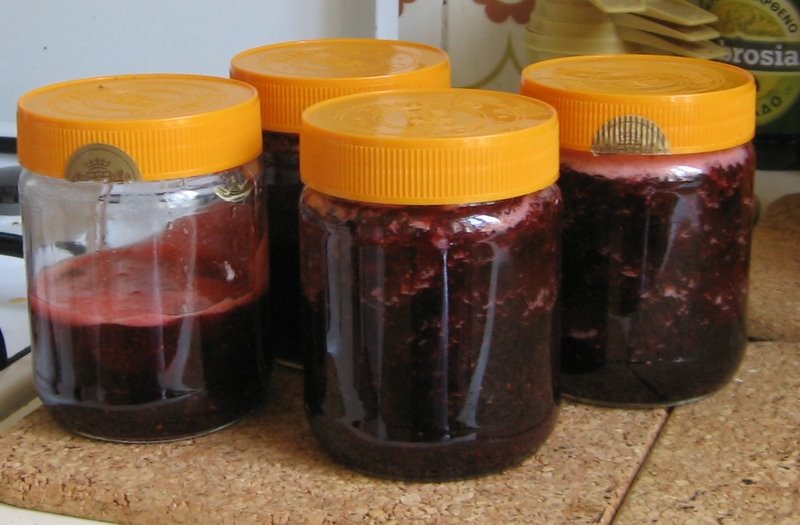
Place the strawberries in a jam-pan or other large saucepan, and chop lightly if they're big. Sprinkle the lemon juice over, then cook gently over a low heat for about 30 minutes until the fruit is very soft, stirring occasionally.
Add the sugar and stir with a wooden spoon until the sugar is fully dissolved, then turn up the heat and boil until the setting stage is reached, stirring occasionally - this takes around 15-20 minutes but depends partly on the temperature of the hob.
Leave to cool for about ten minutes, then put in hot clean jars and seal.
- - - - - - - - - - - - - - - - - - - - - - - - - - - - - - - - - - - - - - - - - - - - - - - - -
Note that this really does need a LARGE pan. After the sugar has been added, the jam gradually creeps higher and higher in the pan as it boils, and is in danger of boiling over unless there is a lot of room.
To test whether the jam has set, put a few drops on a cold plate, leave for a minute, then push your finger gently over the surface. If it's still runny, then it needs more boiling. If it's set, the blob of jam should feel slightly different, and will wrinkle a little as you push your finger over it. Don't leave it too long, however, or the jam will start to burn on the bottom of the pan.
13/04/2006
Chili con Carne

(serves about 4)
500g mince - meat or vegetarian
1/2 cup red lentils, washed and drained (optional)
1 large onion, chopped
1 clove garlic, crushed, or 1 tsp garlic powder
1 chopped green or red bell pepper
400g can crushed tomatoes, or equivalent fresh/frozen
500g mince - meat or vegetarian
1/2 cup red lentils, washed and drained (optional)
1 large onion, chopped
1 clove garlic, crushed, or 1 tsp garlic powder
1 chopped green or red bell pepper
400g can crushed tomatoes, or equivalent fresh/frozen
200g (approx) can or packet of tomato puree
¼ - ½ tsp chili powder, depending on strength
1 tsp turmeric
¼ - ½ tsp chili powder, depending on strength
1 tsp turmeric
1 tsp cumin seeds
125g (4 oz) dried pinto or other red beans (or 1 medium can, drained)
Method:
If using dried beans, soak them overnight in cold water. Drain, and boil rapidly for at least ten minutes, then simmer gently for half an hour or so until softened.
Cook the mince with the pepper, onion and garlic in a large pan, stirring until the mince is brown and the onion transparent. Add the lentils, with a little water if it starts to stick, or a tablespoon of olive oil. Stir in the rest of the ingredients with the drained beans, and a little extra water if the mixture looks too dry. Simmer for about half an hour, adding extra water if necessary.
Alternatively, use a slow-cooker. If you have a large one, you may need to double the ingredients, but this freezes well in individual portions. You can do the pre-cooking as in this recipe, or you can simply dump everything in the slow-cooker, stir well, and leave to simmer on medium for 5-6 hours or longer. The photos shows it cooking in two small crockpots, which is how I usually make it nowadays.
This is a quick and easy recipe for the whole family which is almost infinitely flexible. You can adjust the ingredients to suit your family's tastes. We usually serve with baked potatoes although rice is more traditional, and perhaps some cabbage and peas. It can also be used in enchiladas.
Use any kind of mince: chicken is my preference nowadays, as I try to avoid red meat. But other kinds can work. You could even use vegetarian mince, although it's not then 'con carne' (with meat). The lentils are optional, but we find they make the consistency better, and they add to the protein and fibre content inexpensively. Use more, if you like them.
Use chili powder sparingly, as a small amount goes a long way, particularly if the container is new. If you leave it (and the beans) out altogether, this makes a basic mince and tomato meat dish that can be used in many ways.
125g (4 oz) dried pinto or other red beans (or 1 medium can, drained)
Method:
If using dried beans, soak them overnight in cold water. Drain, and boil rapidly for at least ten minutes, then simmer gently for half an hour or so until softened.
Cook the mince with the pepper, onion and garlic in a large pan, stirring until the mince is brown and the onion transparent. Add the lentils, with a little water if it starts to stick, or a tablespoon of olive oil. Stir in the rest of the ingredients with the drained beans, and a little extra water if the mixture looks too dry. Simmer for about half an hour, adding extra water if necessary.
Alternatively, use a slow-cooker. If you have a large one, you may need to double the ingredients, but this freezes well in individual portions. You can do the pre-cooking as in this recipe, or you can simply dump everything in the slow-cooker, stir well, and leave to simmer on medium for 5-6 hours or longer. The photos shows it cooking in two small crockpots, which is how I usually make it nowadays.
- - - - - - - - - - - - - - - - - - - - - - - - - - - - - - - - - - - - - - - - - - - - - - - - -
This is a quick and easy recipe for the whole family which is almost infinitely flexible. You can adjust the ingredients to suit your family's tastes. We usually serve with baked potatoes although rice is more traditional, and perhaps some cabbage and peas. It can also be used in enchiladas.
Use any kind of mince: chicken is my preference nowadays, as I try to avoid red meat. But other kinds can work. You could even use vegetarian mince, although it's not then 'con carne' (with meat). The lentils are optional, but we find they make the consistency better, and they add to the protein and fibre content inexpensively. Use more, if you like them.
Use chili powder sparingly, as a small amount goes a long way, particularly if the container is new. If you leave it (and the beans) out altogether, this makes a basic mince and tomato meat dish that can be used in many ways.
Lemon Cream Crunch
(serves 4-6)
- - - - - - - - - - -
This is a quick, easy and highly calorific dessert, similar to what is called 'key lime pie' in the USA. I find the digestive biscuit base makes it taste a little like cheesecake, although there is no cheese and no cooking required to make it set. I used to make it over a base consisting of melted chocolate, melted butter and rice crispies. This was popular with small children but rather messy, and did not keep more than a day in the fridge as the rice crispies became soggy.
Base:
100g (4 oz) butter or margarine
200g (8 oz) digestive biscuits (or American graham crackers)
Filling:
400g (14 oz) can sweetened condensed milk
300ml (12 fl oz) whipping cream
3-4 small lemons, juice and grated yellow part of rind (100ml juice)
Method:
Melt the butter in a covered container in the microwave, or very gently in a pan on the hob. Crush the digestive biscuits and stir into the melted butter. Press in the base of a greased 22cm (9-inch) flan tin or serving dish, and cool.
Whip the cream, then fold in the condensed milk until blended. Add in the grated lemon rind and juice, stir quickly, then pour into the base. This sets extremely fast once the lemon juice has been added. Refrigerate. If you like you can sprinkle grated chocolate or sugar strands over the top before serving.
This is a quick, easy and highly calorific dessert, similar to what is called 'key lime pie' in the USA. I find the digestive biscuit base makes it taste a little like cheesecake, although there is no cheese and no cooking required to make it set. I used to make it over a base consisting of melted chocolate, melted butter and rice crispies. This was popular with small children but rather messy, and did not keep more than a day in the fridge as the rice crispies became soggy.
Use unwaxed lemons, and scrub well to get rid of any dirt before grating. If the lemons are large, measure the juice before adding. About 100ml juice is about right - much more than that leaves the filling too runny, although lemony and delicious, if you like a somewhat tart lemon flavour.
I have recently experimented with trying to make this dairy-free. While both whipping cream and condensed milk are available dairy-free, the dessert will not set unless you also use some thickener such as cornflour or tapioca starch. The reason the dairy-based recipe sets so well (and so quickly) is related to the chemical reaction of the acidic lemon juice with the proteins in the dairy products.
My first attempt used 400ml thick canned coconut milk, mixed with 2 tbsp cornflour and 1 tbsp golden syrup, then heated in a pan, stirring, until the mixture was quite thick. I cooled it a little, then stirred in 50ml lemon juice and 120g sweetened condensed coconut milk. I added some vanilla extract too, as the suggested recipe I found listed that, but would leave it out another time.
If you prefer it tarter, you could leave out the golden syrup (and if not vegan could use honey instead). It worked quite well but didn't set as well as the dairy version, and the taste wasn't the same. But still, a good alternative if you want something fairly quick and lemony.
Subscribe to:
Posts (Atom)
Newest recipe
Sweet chili sauce
Makes around 240ml Ingredients: 2-3 small red chilies or 1 bigger 2-3 garlic cloves 90ml water 30ml apple cider vinegar 50g sugar 3/4 tsp sa...
